

Imagine a sunny Saturday: you’ve packed snacks, found the wellies and made it to the park. Your three-year-old, meanwhile, has spotted a tiny bug, a stick shaped like a dinosaur and a leaf that absolutely needs to come home. What if they could capture those discoveries themselves?
For many children, three is a lovely age to try a first camera. Not because every child suddenly has the same skills on their birthday, but because growing hand control, a widening imagination and a new appetite for independence can make pressing the shutter feel genuinely rewarding.
The best cameras for 3 year olds make that first experience simple: easy to hold, straightforward to use and ready for a child’s curious view of the world.
What changes at three, and why a camera can fit
Three-year-olds are wonderfully individual. One may be ready to manage a little gadget, while another would rather tell a story about it than take a photo. Still, around this age, play often begins to include more vivid pretend ideas and more chances to practise small, purposeful movements.
A camera can bring those things together:
- Fine motor practice: gripping a small device, steadying it and pressing a large shutter button involve controlled hand and finger movements.
- Imaginative storytelling: a photo of a puddle might become a dragon’s lake; a picture of a favourite toy can start a whole adventure.
- A little independence: choosing what to photograph gives a child a satisfying sense of ownership. “I took that!”- while an adult stays close by.
These are opportunities for playful practice, not promises that a camera will fast-track development. For more ideas about play and imagination between ages two and three, see Derbyshire Family Health Service’s toddler play guidance. The NHS service recommends giving young children room to explore, create and make up stories.
How to choose a camera that suits little hands and a short attention span
A three-year-old’s first camera does not need a long list of complicated modes. What matters is whether the child can pick it up, work out the main button and enjoy a few minutes of snapping without needing a grown-up to troubleshoot every step.
Before choosing, think about:
- Weight and size: Can your child hold it comfortably and carry it on a short walk?
- Simple controls: Are the buttons easy to find and press?
- A secure, grippy feel: A protective case can help little hands hold on.
- Low-fuss photography: Automatic adjustments can help a child concentrate on what they’re looking at, rather than camera settings.
- A manageable first outing: A five-minute photo hunt is often more fun than expecting a preschooler to document a whole family day out.
For a broader overview of camera features, our guide to choosing a kids’ camera covers the general buying considerations. Here, we’re focusing on what makes a model feel approachable specifically for a three-year-old.
A straightforward first camera: Hoppstar Rookie
The Hoppstar Rookie Blush Digital Camera is listed for ages 3+ and costs £52.49. It weighs 95g and measures 8 x 5 x 4cm, making it a small, light option for children getting used to holding their own camera.
The practical details are the ones that matter most at this age: chunky buttons, a soft, grippy silicone case and automatic features for focus, brightness, colour, face detection, ISO and white balance. That means less menu-tapping and more time looking for something interesting to photograph.
A 16GB SD card is included, with capacity for up to 8,000 photos according to the product information. The camera is rechargeable, with an approximate 150-minute charging time, and the 2-in-1 lanyard incorporates a USB charging cable. It is CE, EN71 and RoHS certified. An adult should handle charging and supervise use of the strap, especially around active play.
The Blush colour has a cat-shaped case, but the key point is its compact, simple-to-hold format. A verified buyer of the bear-shaped Rookie Honey put the size into lovely perspective:
“Cute little camera, bought it as a gift for my nephew. He adores it! For some reason I thought it would be bigger but then it made sense how little it was when I saw it in the hands of a 3 year old.”
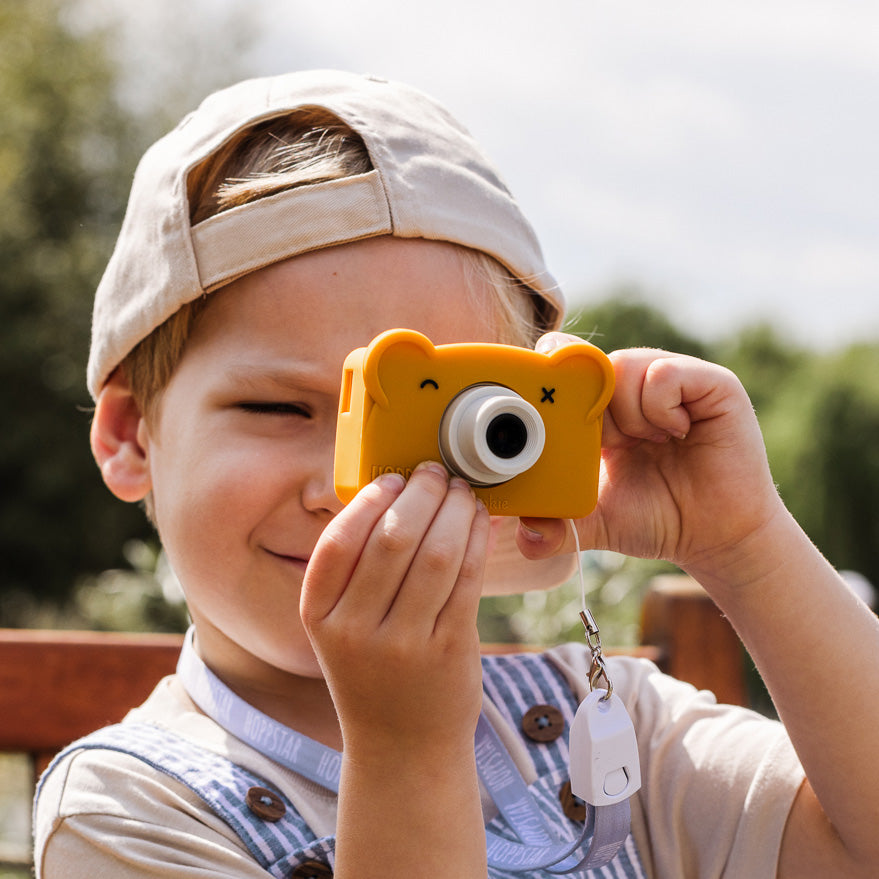
The Hoppstar Rookie Honey is also £52.49, with the same age-3+ Rookie format in a bear-shaped design.
A pocket-sized alternative with extra playful features

If your child is drawn to a compact camera with more playful ways to experiment, take a look at the Hoppstar Popcorn Camera in Breeze. It is currently listed at £32.95, reduced from £40, and includes a 16GB SD card, a built-in selfie camera, filters and photo frames.
Auto focus, white balance, ISO and face recognition help keep the photography side simple. The 2-in-1 neck strap also includes integrated charging. Popcorn is available in Breeze, Bay, Dusk and Sorbet, all listed at £32.95.
Compared with a Rookie, the selfie camera and effects offer more creative options, but that might not be what every three-year-old needs on day one. If you’re choosing for a child who likes uncomplicated routines, start with the simple controls that they’ll actually use. Check the current product listing for age guidance before buying.
Let their confidence grow at their own pace
Some three-year-olds are happy with one big shutter button and a close-up of their favourite toy. Others quickly want to try new ways to use a camera. There’s no need to rush them towards extra features.
For a child ready to explore selfies and video, the Hoppstar Expert Yale is listed for age 3+ at £66.99. The Expert range adds selfie and video modes while keeping a lightweight design, chunky buttons and a soft silicone case.
Later on, when your child is older and interested in making physical keepsakes, the Hoppstar Artist range, with its built-in printer, is the next step. Artist models are for ages 5+, so they’re not the first-camera pick for most three-year-olds.
For more about the Hoppstar range in outdoor play, you can also read our Hoppstar camera review for creative outdoor play.
Make the first photo walk easy and fun
The camera is only part of the activity. Keep the outing short, follow your child’s lead and leave room for all the blurry, unexpected shots. Try one simple prompt:
- Find something tiny.
- Photograph something yellow.
- Take a picture of your favourite tree.
- Pick a toy and make up a story about where it’s going.
- At home, look through the photos together and ask, “What was happening here?”
Keep safety in mind, too. Follow the manufacturer’s guidance, supervise camera and strap use, and keep the camera away from water unless it is specifically described as waterproof. Make crossings, climbing and running camera-free moments. The goal is to enjoy the fresh air and discoveries, not to get a perfect picture.
Cameras for 3 year olds: FAQs
Is three old enough for a first camera?
It can be. The Hoppstar Rookie and Expert ranges are listed for ages 3+, but children develop at different rates. Look for interest, comfortable handling and simple controls, and follow the age guidance on the specific product.
What makes a camera easier for a three-year-old to use?
A light body, grippy case and large, easy-to-find buttons can make holding and taking a photo more manageable. Simple automatic camera features also mean fewer settings for a young child to navigate.
Will a camera help my child’s development?
Photography can give children a playful chance to practise controlled hand movements, notice details and tell stories about what they see. It’s best thought of as one enjoyable activity, not a developmental programme or a guarantee of particular outcomes.
How long should a first photo activity be?
Start small. A short garden wander or a five-minute “find something interesting” game is plenty. If your child is still keen, keep exploring; if they’re ready for a snack or a different game, that’s fine too.
Can I spread the cost?
ClearPay offers 0% interest split payments, subject to its terms. Let’s Play Outside also offers a 30-day money-back guarantee, free UK shipping on orders over £100, and 10% off a first order when you sign up to the newsletter.
Final thoughts
A first camera is a small invitation to see an ordinary walk differently. Your three-year-old may come home with photos of shoes, leaves and the same toy from six angles, but behind each snap is a choice about what caught their eye.
Keep it simple, stay close and let them lead. The best part isn’t the photo gallery; it’s the fresh air, the stories you make together and the little moments of confidence along the way.


